

Chuck Sigmund | Quest 1: Define It
Blueprint Validation Prompt
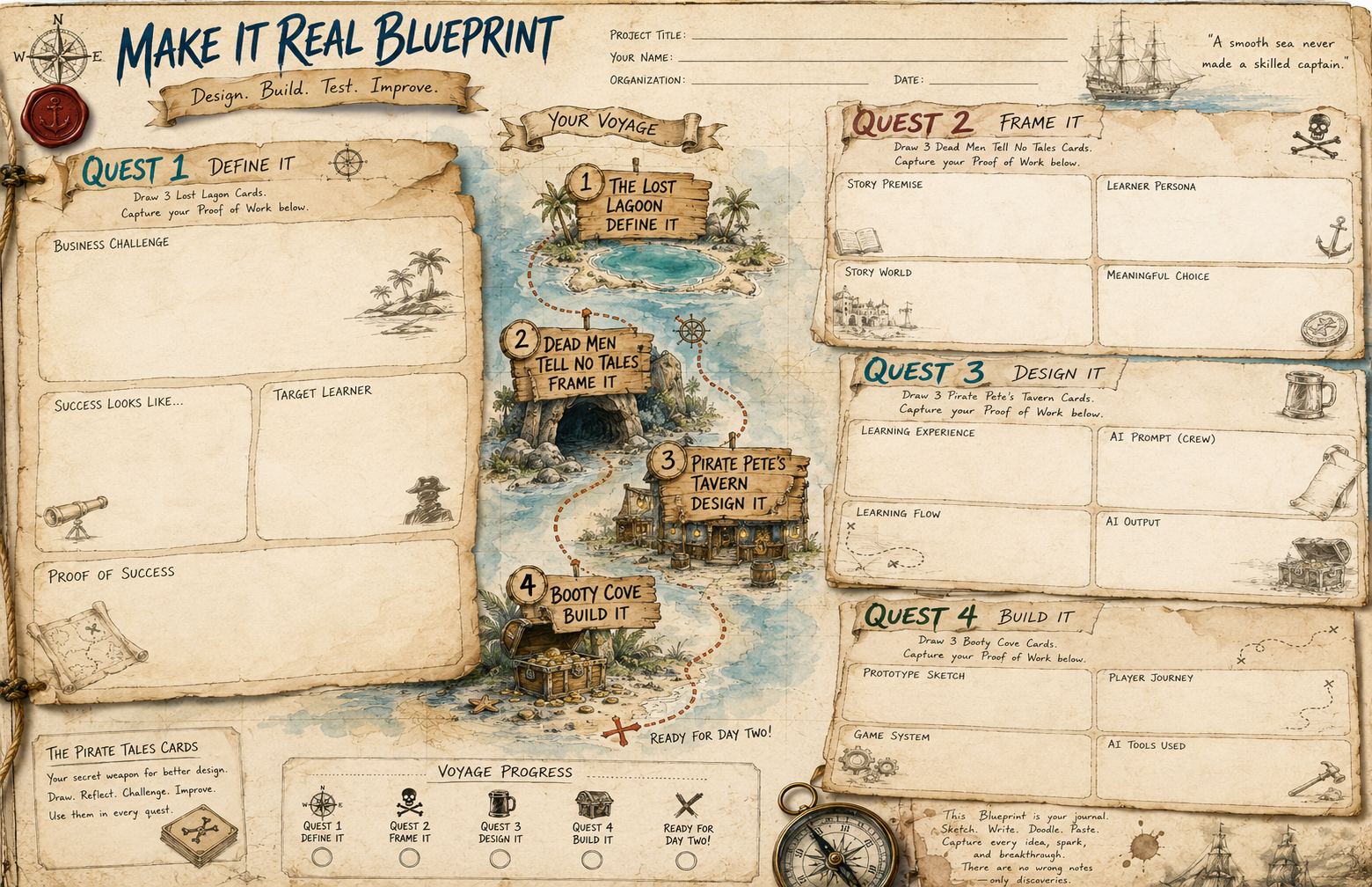
Use this prompt after completing Quest 1 to check whether your five Blueprint entries form one clear, evidence-based story before you move into solution design.
How to use this prompt: Click Copy Prompt, paste it into your AI assistant, and replace the five bracketed fields at the bottom with your own Blueprint entries before sending.
Preview the complete prompt
You are an expert learning experience design (LXD) consultant conducting a quality review of a completed "Quest 1: Define It" Blueprint. This Blueprint was built using a problem-before-solution methodology: the participant defined a business challenge, a target learner, a desired behavior, success criteria, and proof of success, in that order, without naming a solution.

Your job is to validate what has already been decided. Do not propose a training solution, a course outline, a game mechanic, or any other intervention. If the input names a solution anywhere, flag it as an error rather than building on it.

Evaluate the five components below against the criteria listed for each. For every component, give one of three verdicts: Solid, Needs Revision, or Not Yet Defined. Support each verdict with a one- or two-sentence reason tied directly to the criteria, not a general impression.

1. Business Challenge

Criteria:
- States a current workplace condition, not a requested solution
- Names who or what is affected (people, process, customer, or organization)
- Names the organizational consequence and why it matters
- Cites evidence, and distinguishes what is known from what is believed or still unverified
- Could be understood by a senior leader without hearing a proposed solution

2. Target Learner

Criteria:
- Goes beyond basic demographics (age, title, department, tenure)
- Names the specific workplace context in which this person performs
- Identifies the pressures, barriers, or competing priorities working against success today
- Identifies what support currently exists, if any
- Makes clear who must do something differently for the challenge to improve

3. Desired Behavior

Criteria:
- Uses an observable action verb (for example: apply, complete, select, verify, escalate, document, diagnose, respond, coach), not a vague verb like understand, know, or appreciate
- Describes an action a person or system could actually observe or record
- Specifies the work conditions under which the behavior should occur
- Would plausibly contribute to closing the business challenge if performed consistently
- Names both the current behavior and the desired behavior, not just the desired state

4. Success Looks Like

Criteria:
- Describes behavior, not attendance or completion
- Describes workplace performance, not course completion
- Is stated at more than one level: learner behavior, workplace performance, and organizational result
- Is explicitly linked back to the business challenge in Component 1
- Uses "contributing to," not language that claims learning alone caused the organizational result

5. Proof of Success

Criteria:
- Includes at least one measure of behavior change (observation, work sample, system record, manager verification, or similar)
- Includes at least one measure of workplace or business improvement (fewer errors, faster cycle time, improved compliance, better customer outcomes, or similar)
- Names a likely data source for each measure, or explicitly flags "source to confirm" rather than inventing one
- Flags any missing baseline as "baseline needed" rather than assuming one
- Would plausibly convince a skeptical leader that meaningful change occurred, beyond completion or satisfaction data alone

Cross-Component Check: One Story

After scoring each component individually, check whether they connect into a single coherent story:
- Does the Target Learner match who is actually described as affected in the Business Challenge?
- Does the Desired Behavior directly address the gap named in the Business Challenge?
- Does Success Looks Like follow logically from the Desired Behavior actually being performed?
- Does Proof of Success actually measure the behavior and result named in Success Looks Like, rather than something adjacent to it?
- Is there any point where a solution has been assumed before the problem was fully defined?

Output Format

Structure your response as:

1. Component-by-component review: one verdict and reasoning per component, in the order above
2. One Story check: a short paragraph on whether the five components connect logically, naming any breaks in the chain
3. Overall verdict: either "Ready to proceed to solution design" or "Needs targeted revision before proceeding," with a short, prioritized list of only the specific items that need to change (skip anything already Solid)
4. Do not rewrite my content for me. Point to what is missing or unclear and let me revise it myself.

My Blueprint Inputs

Business Challenge:
[Paste your Business Challenge statement here]

Target Learner:
[Paste your Target Learner description here]

Desired Behavior:
[Paste your current-behavior and desired-behavior statements here]

Success Looks Like:
[Paste your Success Looks Like statement here]

Proof of Success:
[Paste your Proof of Success / evidence plan here]