

The B❒X as a Game System for Learning Design
Mar 29, 2026What if the most engaging learning experience you design this year doesn’t require new technology, a new platform, or even new content? What if it starts with something much simpler… a box?
At first glance, the B❒X is a tool for reflection, creativity, and strategic thinking. It helps participants explore mindset, examine behavior, and identify opportunities for change. But when you step back and look at how the experience actually unfolds, something else becomes clear. The B❒X is not just an activity. It functions as a complete system.
And more importantly, it already contains the elements of a well-designed game.
This is the shift I want facilitators to make: you’re not adding gamification to the B❒X. You’re revealing the game mechanics already embedded within it.
Seeing the B❒X Differently
Most conversations around gamification focus on what to add. Points, badges, leaderboards, rewards. Those elements can have a place, but they often miss something more fundamental. The most powerful learning experiences are not built by layering mechanics on top. They are built by recognizing the structure that is already there and designing it intentionally.
The B❒X already has structure, progression, tension, identity, and transformation built into it. When you begin to see it through that lens, you stop asking, “How do I gamify this?” and start asking, “What game is already being played here?” What looks like a sequence of steps is actually a progression system, where participants move from awareness to expansion. What looks like personalization is identity design, where the B❒X becomes an avatar of the learner. What looks like reflection is feedback, where thinking becomes visible. And what looks like simple interaction is choice, where participants decide what to open, change, or keep.
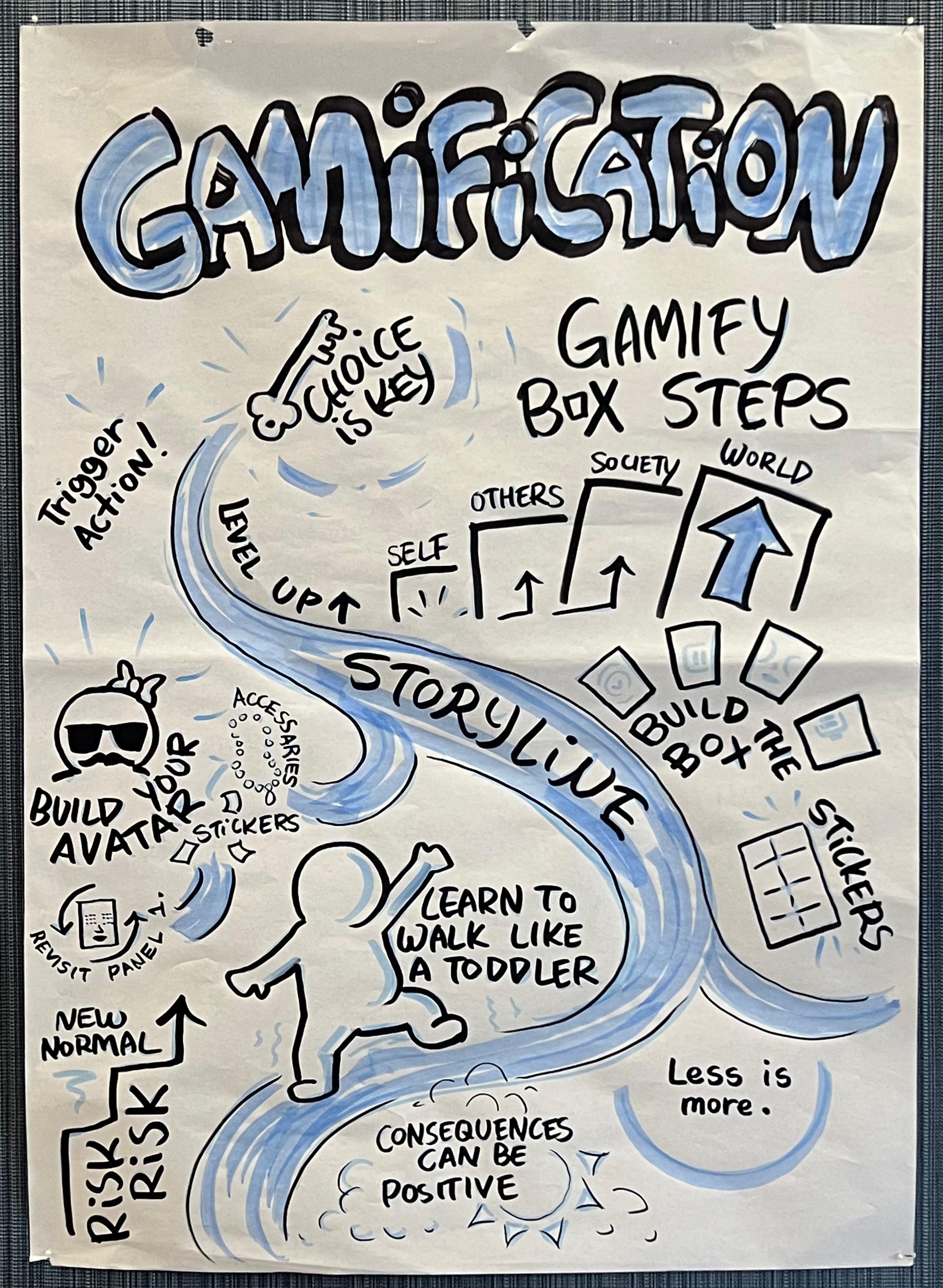
Constraint: The B❒X Focuses Thinking
It’s easy to assume that the B❒X limits participants. After all, it restricts vision, introduces structure, and creates a defined space for thinking. But that limitation is not a flaw. It is a design feature.
Constraint is what sharpens thinking.
When participants wear the B❒X or work within its structure, they are forced to make decisions differently. They cannot rely on worn-out patterns. They must adapt. That is where creativity begins. Instead of trying to remove the constraint, facilitators can lean into it by asking better questions. What is the B❒X forcing you to notice? What is it preventing you from doing? Those questions unlock new possibilities.
Triggers: The B❒X Moves People to Action
The B❒X is not just reflective. It is behavioral.
Throughout the experience, participants encounter signals. They feel boxed in. They experience pressure. They become aware of patterns in their thinking and behavior. These are not passive observations. They are triggers.
When designed intentionally, those triggers can drive action.
This is where learning moves beyond insight. When participants begin to associate specific feelings with specific responses, the experience becomes practical. When I feel stuck, I open a panel. When I feel pressure, I use my breakthrough password. The B❒X becomes something they use in real situations, not just something they complete during a session.
Risk and Safety: The Tension That Drives Change
One of the most interesting aspects of the B❒X is the tension it creates. On one hand, it represents safety and success. On the other, it represents limitation and pressure. That tension is not accidental. It mirrors the way people experience change in the real world.
Effective learning sits in that space between comfort and discomfort.
If everything feels safe, nothing changes. If everything feels risky, people shut down. The B❒X allows facilitators to guide participants through that balance. They can create moments where people feel grounded, then stretch them just enough to challenge their thinking, and then provide support again. That rhythm—safe, stretch, support—is what makes the experience memorable and meaningful.
Social Play: Expanding Thinking Through Others
The B❒X is often experienced individually at first. Participants build it, personalize it, and reflect on their own thinking. But something important happens when those B❒Xes begin to connect.
The experience shifts from individual insight to shared understanding.
Learning accelerates when people see beyond their own perspective.
When participants share their B❒X, compare panels, and connect their thinking, they begin to see patterns they could not see alone. Facilitators can intentionally design for this by creating moments for pair work, group discussion, and collective reflection. The question becomes, what becomes possible only when these perspectives come together?
Transformation: Making Change Visible
Many learning experiences talk about transformation, but few make it visible. The B❒X does.
Participants move through a clear progression. They begin with their current thinking, recognize where they feel stuck, explore new strategies, and begin to build a better version of their B❒X. By the end of the experience, something has shifted.
And that shift is tangible.
Participants can see it in what they wrote. They can feel it in how they think. They can articulate what is different. When facilitators ask them to compare their starting point with where they are now, the change becomes real. It is no longer abstract. It is something they can point to and describe.
Continuity: Extending the Experience Beyond the Room
Perhaps the most overlooked aspect of the B❒X is its potential to continue beyond the session. Too often, learning experiences end when the session ends. The B❒X does not have to.
Participants leave with more than an idea. They leave with a physical artifact, a set of signals, and a personal strategy for responding to those signals.
The real impact happens when they continue to use it.
Encouraging participants to keep their B❒X nearby, revisit it when they feel stuck, and use their breakthrough password in real situations extends the experience into their daily work. The session becomes the starting point, not the conclusion.
The Shift That Changes Everything
When you look at the B❒X through this lens, the conclusion is clear.
The B❒X is not the activity. It is the system.
And gamification is not something you need to add to it. It is something you need to recognize within it. The structure, the progression, the tension, the interaction, and the transformation are already there.
What changes is not the box.
What changes is how you design the experience around it.
If you’re ready to see what’s possible with the B❒X for your clients or teams, let’s explore it together.
Book time on my calendar or send me a quick email, and we’ll take the next step.
Don't miss a beat!
New moves, motivation, and classes delivered to your inbox.
We hate SPAM. We will never sell your information, for any reason.