
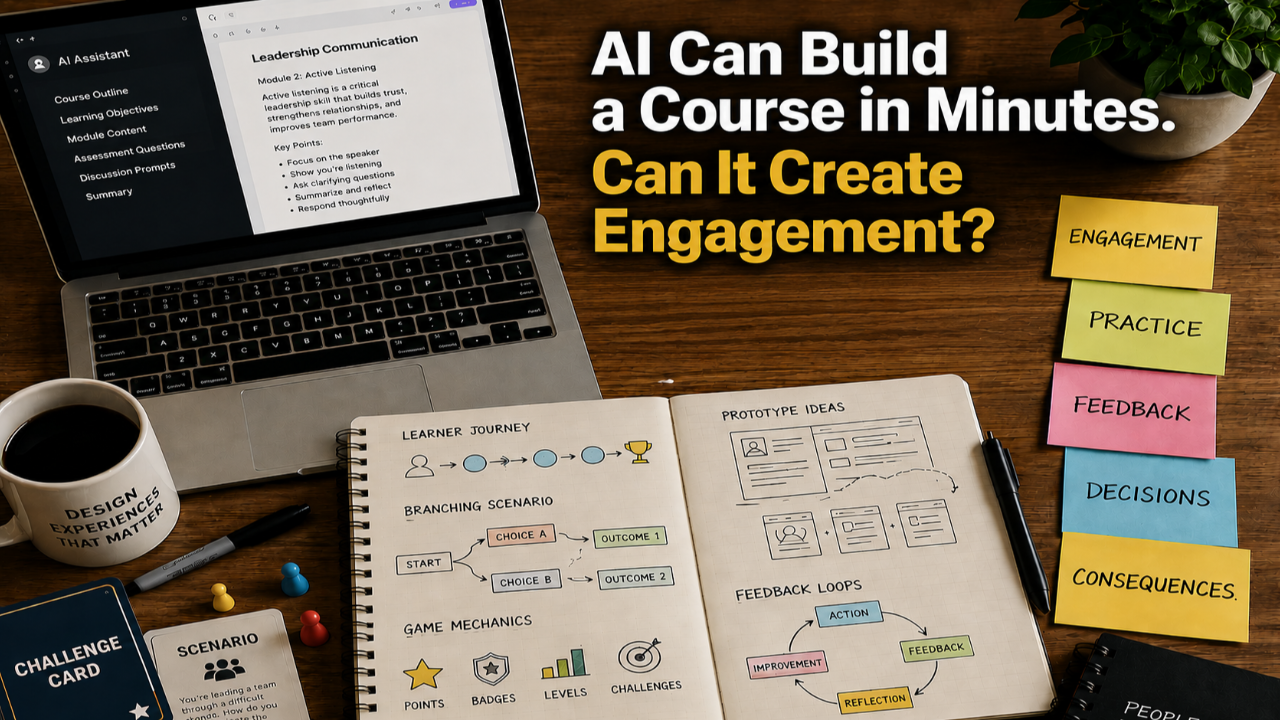
AI Can Build a Course in Minutes. Now What?
Jun 15, 2026If you spend any time reading posts about learning and development these days, it would be easy to conclude that AI has solved all of our problems.
Need a course outline? AI can create one. Need assessment questions? AI can write them. Need images, scenarios, job aids, facilitator guides, role plays, discussion questions, or a slide deck? AI can help with all of those as well.
As impressive as those capabilities are, I can't help but wonder if we're focusing on the wrong challenge.
For years, instructional designers, eLearning developers, trainers, facilitators, educators, coaches, and CLOs have been trying to solve some very difficult problems. How do we increase learner engagement? How do we improve retention? How do we create meaningful behavior change? How do we personalize learning? How do we demonstrate business impact? How do we move beyond content consumption and create actual capability?
Those are the questions I hear over and over again from our community. The reality is that most organizations don't have a content problem. They have an engagement problem.
Employees aren't completing training. Learners aren't retaining information. Managers aren't seeing behavior change. Organizations are investing significant resources in learning initiatives and then struggling to demonstrate measurable impact.
Adding more content won't solve those challenges.
Creating content has never been the goal. Creating better learning experiences is the goal.
That's one of the reasons I'm so interested in the intersection of AI, gamification, and game-based learning.
A growing body of research suggests that thoughtfully designed gamified learning experiences can improve engagement, participation, persistence, and learning outcomes. A 2023 peer-reviewed meta-analysis published in Frontiers in Psychology reviewed 41 studies involving more than 5,000 participants and found a statistically significant positive effect of gamification on learning outcomes when compared to non-gamified instruction.
What I appreciate about this research is that it doesn't make exaggerated claims. The researchers noted that results depended heavily on the quality of the instructional design and how intentionally gameful elements were aligned with learning goals.
In other words, gamification is not a shortcut.
You can read the research here: https://www.frontiersin.org/journals/psychology/articles/10.3389/fpsyg.2023.1253549/full
That finding aligns closely with the work of Richard Landers, one of the leading researchers in workplace gamification. He argues that gamification itself does not directly improve performance. Instead, it improves the behaviors that support performance. When learners spend more time practicing, participate more actively, persist longer, seek feedback, and engage in meaningful repetition, performance improvements often follow.
That distinction matters because it changes the conversation from "Did people enjoy the training?" to "Did the training create the behaviors that support better performance?"
That's a conversation executives understand.
Interestingly, workplace research points in a similar direction. Researchers from Harvard Business School and Columbia University studied gamified workplace training systems and found positive effects on employee performance in the organizational context they examined. Their findings suggest that gameful systems can positively influence motivation and participation when they are intentionally aligned with business goals.
The research can be found here: https://www.hbs.edu/faculty/Pages/item.aspx?num=55888
It's also a conversation that becomes increasingly important as AI tools become more common in our profession.
Right now, many learning professionals are experimenting with AI to create content faster. That's understandable. Most teams are being asked to do more with fewer resources, and the ability to accelerate development work is attractive.
But what happens when every organization has access to the same tools? What happens when everyone can generate a course outline, create an image, write assessment questions, and produce learning content in a matter of minutes? At that point, content is no longer the differentiator.
Experience design becomes the differentiator.
The organizations that stand out will be the ones creating learning experiences that invite curiosity, encourage experimentation, provide meaningful feedback, and allow learners to practice in realistic contexts. They will create experiences where people make decisions, experience consequences, reflect on outcomes, and improve through repetition.
This is one of the reasons I am excited about the role AI may play in simulations, role plays, and immersive learning experiences.
We already have evidence that active participation matters. PwC's workplace learning research comparing VR-based soft skills training with classroom and eLearning formats found that learners reported greater confidence applying skills after immersive learning experiences. While the study focused specifically on VR training rather than gamification broadly, it reinforces something many learning professionals have observed for years.
People learn differently when they are actively involved in the experience. They learn differently when they are required to make decisions. They learn differently when they can practice in a psychologically safe environment before the consequences become real.
The research can be found here: https://www.pwc.com/us/en/tech-effect/emerging-tech/virtual-reality-study.html
Before we all rush off to add AI-generated badges and leaderboards to everything, the research also offers an important caution.
The evidence does not strongly support shallow gamification. In fact, several studies have found that points, badges, and leaderboards alone do not reliably improve learning outcomes and may actually reduce motivation when they feel manipulative or disconnected from meaningful work.
The strongest outcomes tend to occur when learning experiences support autonomy, provide meaningful feedback, encourage progression toward mastery, connect directly to real-world challenges, and allow learners to make decisions and experience consequences.
That's an important reminder for anyone exploring AI in learning and development.
AI can help us build experiences faster. It cannot tell us whether those experiences are worth having.
That's where instructional design, gamification, game-based learning, and human-centered learning continue to matter.
Imagine using AI to create branching scenarios tailored to different learner personas. Imagine building realistic simulations that allow learners to practice difficult conversations before having them in the real world. Imagine testing multiple game mechanics, narratives, challenges, and feedback systems before committing months of development effort.
Now we're talking about something far more powerful than content generation. We're talking about creating experiences that learners remember.
This September at GamiCon ATX 2026, that's the conversation we'll be having in Austin.
We won't be gathering simply to talk about AI tools. There are plenty of conferences doing that already. Instead, we'll be exploring how AI can support gamification, game-based learning, simulations, onboarding, coaching, storytelling, learner engagement, and performance improvement.
Most importantly, we'll be exploring how these tools can help us create learning experiences that people actually want to engage with.
Because at the end of the day, AI is not the story. The learner is still the story. The challenge is still the story. The behavior change is still the story. AI is simply another tool that can help us design better journeys.
And if the research tells us anything, it's that engagement is not fluff. Engagement is the beginning of participation, participation leads to practice, and practice is what ultimately creates capability.
That's the future I'm interested in building.
Don't miss a beat!
New moves, motivation, and classes delivered to your inbox.
We hate SPAM. We will never sell your information, for any reason.