
What Can Corporate Training Learn From Vocational Education?
Oct 17, 2026Three questions that matter whether you're teaching future engineers, developing supervisors, or preparing employees for the workplace.
I've spent a good portion of the past few weeks thinking about the future of Sententia. Where do we go next? Who needs what we do? And how do we continue helping people design learning that actually makes a difference?
You know, those small, relaxing questions you ask yourself during strategic planning.
One area Jonathan and I are exploring is education, particularly vocational education and workforce development. We've had conversations with people who believe there are opportunities for organizations like ours to support schools and training institutions. Whether those opportunities translate into actual projects is something we're still investigating.
But the conversations have me looking at education through a slightly different lens.
And then, this morning, I came across a research paper that made me stop and think.
Different Classrooms. Surprisingly Familiar Challenges.
The paper, Applying Gamification in Vocational and Professional Education and Training (VPET) Classroom to Engage Students' Learning, by Gloria Kit-man Chung and Nichole Hing-yui Chan of Hong Kong's Vocational Training Council, examines how educators incorporated gameful approaches into three very different learning environments.
The research isn't new, and it isn't claiming that games magically solve every learning problem. What caught my attention were the practical examples of educators making deliberate choices about how people learn.
In one classroom, students were learning pharmaceutical regulations. I don't know about you, but that doesn't immediately sound like the setting for an exciting game.
Instead of relying exclusively on lectures about regulations, the instructor created a workplace scenario. Students became pharmaceutical company employees responsible for registering a product. They worked in teams, completed documentation, made decisions, and dealt with challenges that resembled the work they might eventually perform.
In another classroom, students were developing critical thinking skills. Rather than simply explaining the importance of critical thinking, the instructor used mysteries, visual challenges, and activities that required students to question assumptions and defend their reasoning.
And in an electrical engineering program, students took on the role of engineers responding to people trapped in a lift. Using augmented and virtual reality, they practiced safety procedures in a simulated rescue scenario where mistakes became opportunities to try again.
Three very different subjects. Three different approaches.
And one rather important commonality.
The educators were doing more than delivering information. They were creating opportunities for learners to use it.
Knowing Something Is Not the Same as Being Able to Do It
This is a conversation I've been having with instructional designers, facilitators, and corporate learning professionals for years.
We spend enormous amounts of time deciding what learners need to know. We organize the content, develop the slides, create the activities, write the assessments, and make sure everything aligns with the learning objectives. Then we celebrate when someone passes the quiz. Wonderful. They know the answer.
But what happens when they have to use that knowledge on a Tuesday afternoon, when the situation is messy, the supervisor is unavailable, and the customer is already irritated?
That's the moment I'm interested in.
The research paper uses three familiar learning domains: cognitive, affective, and psychomotor. Together, they offer a useful way to examine what our learning experiences are actually preparing people to do. I've been thinking about them in simpler terms.
KNOW IT. CARE ABOUT IT. DO IT.
KNOW IT: What must learners understand?
The cognitive domain deals with knowledge, understanding, and intellectual skills.
In the pharmaceutical example, learners needed to understand regulations and how to apply them to registration decisions. The instructor didn't eliminate the need for knowledge. Instead, the instructor gave that knowledge a purpose.
There's an important distinction here. Information is necessary. But information becomes more useful when learners have something meaningful to do with it.
Think about the last course you designed. How much time did learners spend receiving information, and how much time did they spend making decisions with it?
CARE ABOUT IT: Why would learners want to use what they've learned?
The affective domain involves attitudes, values, feelings, and motivation. This is where learning design gets particularly interesting to me.
We can tell someone that giving feedback is important. We can explain the steps, show examples, and provide a beautifully designed job aid.
But if that person believes feedback conversations are uncomfortable, unnecessary, or likely to create conflict, how much of that training will show up in their next conversation?
Knowing what to do doesn't automatically mean someone wants to do it.
The critical thinking activities described in the research encouraged students to investigate, question, discuss, and reconsider their assumptions. They weren't simply memorizing a definition of critical thinking. They were experiencing what it required.
And that raises another question for those of us designing workplace learning. Are we paying enough attention to what learners believe, value, and fear, or are we assuming that presenting the right information will take care of everything?
DO IT: What must learners actually be able to perform?
The psychomotor domain concerns physical movement, coordination, and practical skills.
In the electrical engineering example, learners practiced lift safety procedures through a simulated rescue. The scenario gave them opportunities to make decisions, receive feedback, and practice procedures without exposing real people or equipment to the consequences of their mistakes.
Of course, not every workplace behavior is a physical skill. Giving feedback, solving problems, making decisions, and adopting a new process also require application, even though they involve other learning domains.
But the broader design question remains valuable. What must learners be able to do when the training is over?
And perhaps more importantly, have we given them opportunities to practice that behavior under conditions that resemble the real world? Because watching someone demonstrate a skill and being able to perform it yourself are two very different accomplishments.
Just ask anyone who has watched a five-minute home improvement video and then spent the next three hours wondering why there are six screws left over.
What Does This Have to Do With Learning Experience Design?
Quite a lot, actually.
Instructional design provides essential methods for organizing learning, defining objectives, developing instruction, and evaluating results. Those capabilities don't disappear when we talk about Learning Experience Design (LXD).
LXD asks us to widen our view.
What is happening in the learner's world before the learning begins? What motivates or discourages them? What opportunities will they have to practice? What happens after the learning event? And what will help them succeed when they're back in the environment where the behavior actually matters?
This is also where I believe gamification and game-based learning can make a meaningful contribution. Not because every course needs points, badges, or a leaderboard. And certainly not because adding a game automatically improves learning. But because thoughtful gameful design can create meaningful challenges, provide feedback, support experimentation, offer choices, and help learners see their progress.
The game mechanic isn't the starting point. The learner is.
The research paper also acknowledges the limitations and challenges of gamification, including design time, different learner preferences, and the need for more evidence about its effectiveness in particular settings.
Good. We should be asking those questions. The goal isn't to gamify everything. The goal is to make better design decisions.
Why This Matters to Sententia's Future
As Jonathan and I continue working on Sententia's strategic plan, I'm becoming increasingly curious about what our work might contribute to vocational education, workforce development, and other educational settings.
We haven't decided that schools are our next big market. We haven't established that funding is readily available or that institutions are waiting for us to show up. We're asking questions, having conversations, and looking for places where our experience and methodology might address a genuine need.
But this research reminded me that the challenges facing a vocational instructor aren't necessarily that different from those facing a corporate instructional designer. Both may be working with limited time and resources. Both need learners to develop knowledge and skills. Both want people to leave the learning environment better prepared for what comes next.
And both can benefit from asking whether they're designing for the learning event or for the moment when learning has to work.
Different settings. Different constraints. Same human beings trying to learn something that matters. That's a conversation I want to keep exploring.
Your Five-Minute Learning Design Challenge
I've created a simple KNOW IT. CARE ABOUT IT. DO IT. infographic to help you examine a learning experience you're currently designing or facilitating.
Choose one course, workshop, or learning activity. Then ask yourself:
1. KNOW IT: What must learners understand, and how will they use that knowledge to make decisions?
2. CARE ABOUT IT: What would give learners a reason to value, attempt, or continue the desired behavior?
3. DO IT: What must learners actually be able to perform, and where will they have opportunities to practice?
Now comes the question that matters most.
Are you designing for the moment when learners must demonstrate what they've learned, or primarily for the moment when they finish the course?
You might discover that your learning experience is already doing a terrific job. Or you might identify one small design change that could make a meaningful difference. Either way, that's five minutes well spent.
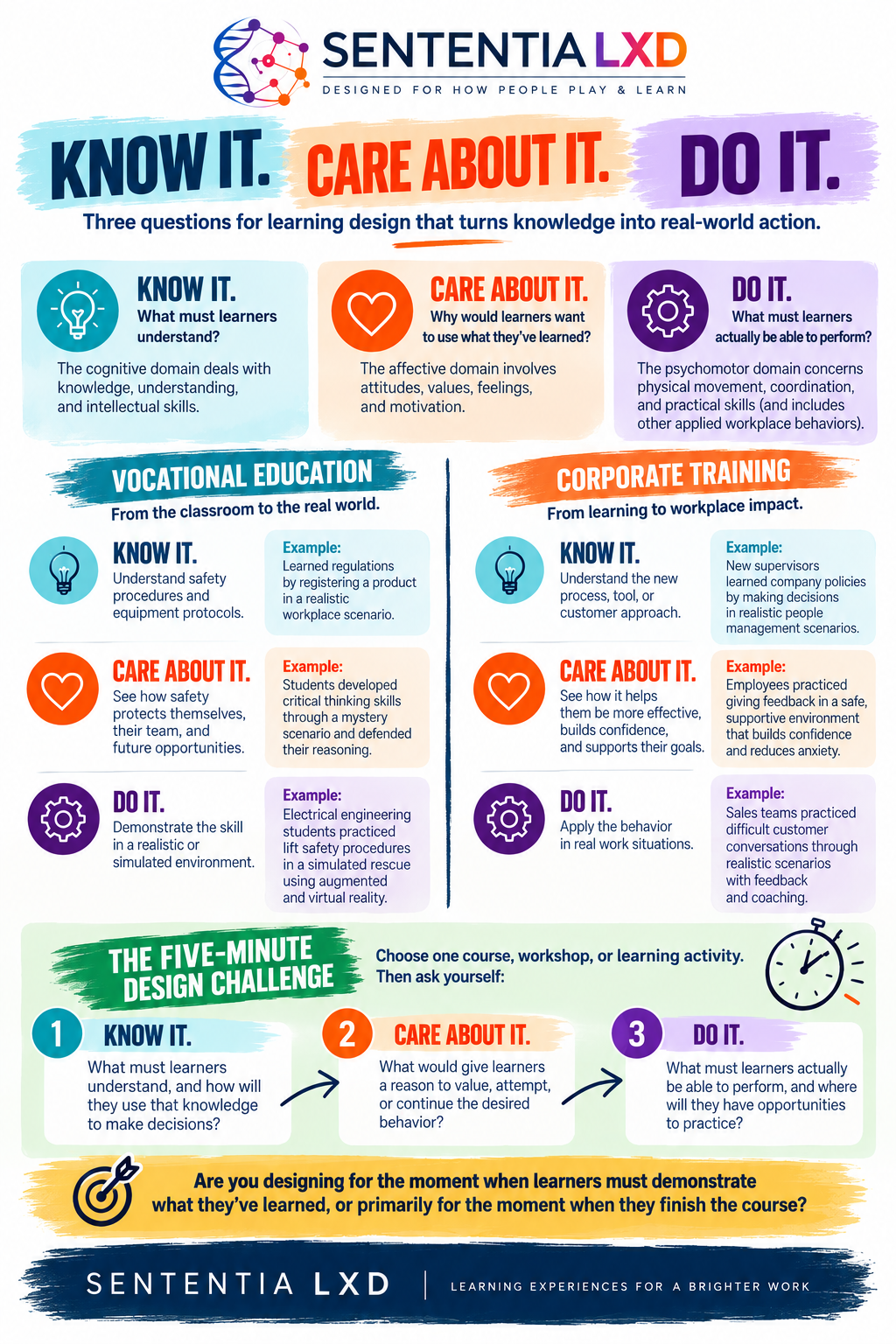
Download the infographic, try the challenge with your next project, and share it with a colleague who might find it useful.
Want to Put These Ideas Into Practice?
These are exactly the kinds of design questions we're exploring in the newly redesigned Gamification Surveyor Certification (Level 1), happening live online October 22–23, 2026.
We're bringing more Learning Experience Design, more meaningful design decisions, and more practical AI into the experience, while building on the motivation science and gameful design methodology that have shaped Sententia's work for years.
And yes, you'll still earn 6 recertification credits through ATD, SHRM, and HRCI.
If you're ready to move beyond simply presenting content and start designing learning experiences that help people do something differently, I'd love to have you join us.
Explore the Gamification Surveyor Certification (Level 1)
Because knowing is good.
Doing is better.
Research that inspired this article: Chung, G. K., & Chan, N. H., “Applying Gamification in Vocational and Professional Education and Training (VPET) Classroom to Engage Students' Learning,” Centre for Teaching and Learning, Vocational Training Council, Hong Kong.
Don't miss a beat!
New moves, motivation, and classes delivered to your inbox.
We hate SPAM. We will never sell your information, for any reason.