
Why Have We Accepted Boredom as the Price of Compliance?
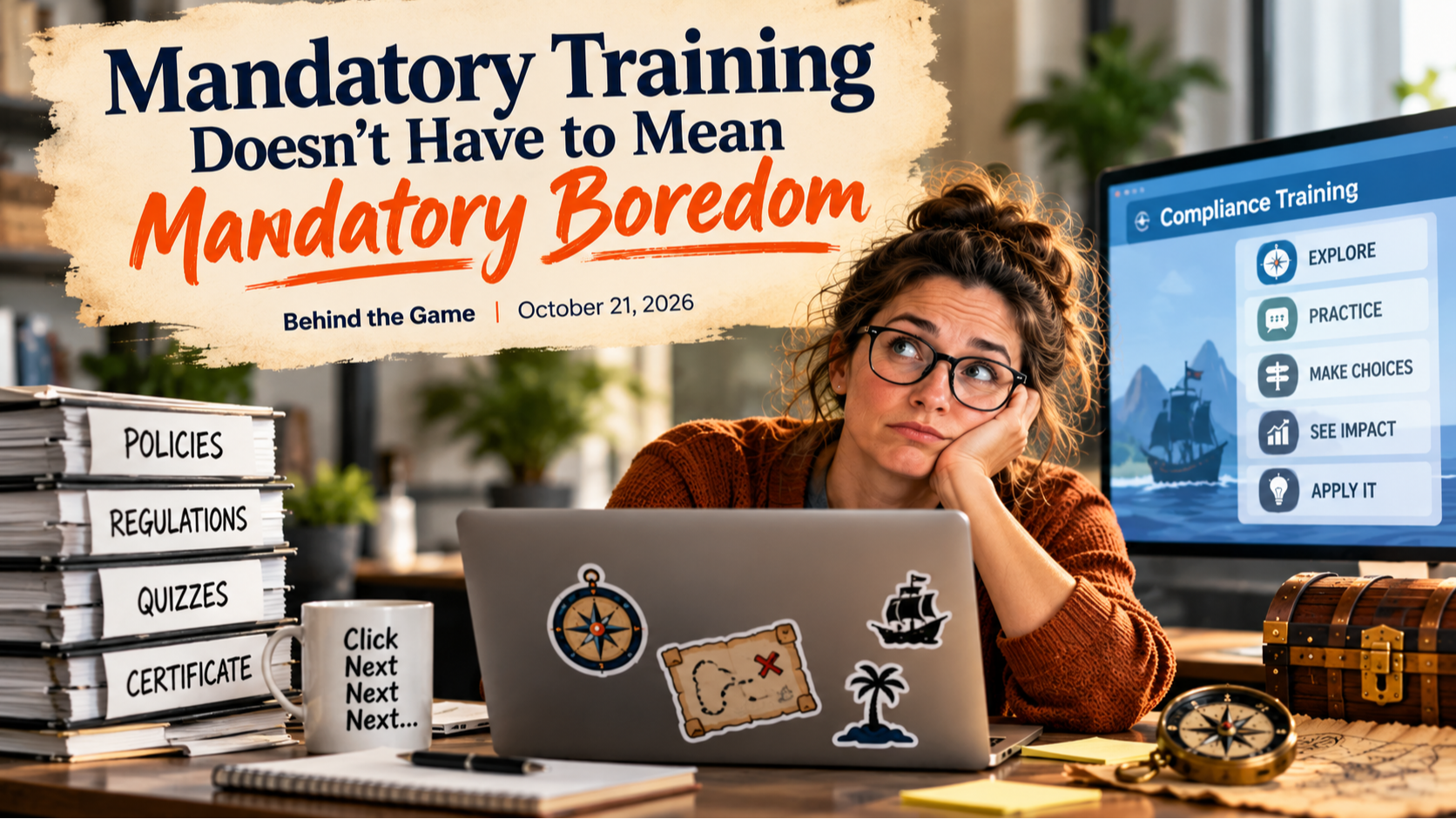
Oct 21, 2026Mandatory training doesn't have to mean mandatory boredom. And serious content doesn't require a miserable learning experience.
There's a particular kind of email that can make an otherwise productive employee suddenly remember an urgent task that needs attention. It's the annual reminder that mandatory compliance training is due. Again. You know what's coming: a presentation full of policies, a narrator reading every word on the screen, and a Next button that seems determined to test your patience rather than your knowledge.
Eventually, you arrive at the assessment, where you're asked questions like, "Is workplace harassment acceptable?" or "Should you share your password with strangers?" You correctly identify the obvious answers, receive your certificate, and return to work. Congratulations! You've successfully demonstrated that you can remain conscious long enough to complete the course.
Now, I recognize that I'm exaggerating a little. I've also been in the training business long enough to know that not every compliance course is terrible. But I've seen enough checkbox training to wonder why we've accepted this approach as normal. If the subject is important enough to require employees' time, shouldn't the learning experience be important enough to design well?
What the Research Says About the Dark Side of Gamification
I recently revisited a research chapter titled How to Avoid the Dark Side of Gamification: Ten Business Scenarios and Their Unintended Consequences, written by Rachel C. Callan, Kristina N. Bauer, and Richard N. Landers. The authors examine ten hypothetical workplace situations involving recruitment, onboarding, employee training, and performance management. Using established psychological theories, they explore how gamification can produce unintended consequences when designers focus on game mechanics without fully considering the behaviors those mechanics encourage.
One example involves an organization awarding points to job applicants for visiting pages on its recruitment website. The organization wants applicants to learn about its values and culture, but the system rewards clicking through pages rather than understanding the information. Another example involves employees earning badges for activities in an online learning catalog. The organization hopes to encourage meaningful professional development, but its rewards may simply encourage employees to collect badges.
The authors make an important distinction: Rewarding an activity does not guarantee that we're rewarding the behavior we actually want. When designers choose convenient measures, such as clicks, completions, or number of posts, they risk encouraging those activities at the expense of deeper learning and performance.
That argument extends well beyond gamification. Traditional training programs frequently make the same mistake, rewarding course completion while collecting little evidence that employees can apply what they've learned. We can count the certificates. Counting meaningful behavior change is considerably harder.
The Recommendation That Made Me Stop Reading
The chapter includes a hypothetical organization struggling with mandatory sexual harassment training. Only 35% of employees have completed the course by the required deadline, so the training designer proposes adding game fiction. Employees would complete quests, defeat monsters representing knowledge assessments, and advance through levels as they progressed.
The authors raise concerns that employees might resent having additional game elements imposed on an already unpopular requirement. They also draw on organizational justice research, which examines how employees perceive fairness in workplace practices. If people believe they're being treated unfairly, adding more requirements or unnecessary complications may make matters worse rather than better.
I think those concerns deserve serious consideration. Turning harassment prevention into a monster-slaying adventure could trivialize the subject, distract learners, or simply make an already frustrating experience more complicated. Poor gamification can absolutely make bad training worse.
But then the authors recommend restricting gamification to training situations where both the training itself and participation in the gameful experience are voluntary.
Wait. What?
That's where I respectfully disagree. Employees don't get to choose whether they complete harassment prevention, cybersecurity, workplace safety, or other required training. Those subjects matter, and organizations have legitimate reasons for requiring participation. But I don't see why mandatory participation should mean abandoning the opportunity to make learning meaningful, enjoyable, and worth employees' time.
Compliance is the requirement. Boredom is a design choice.
Serious Content Doesn't Have to Be Miserable
Somewhere along the way, we seem to have confused taking a subject seriously with making the training painfully dull. But those are two very different things, and understanding that distinction changes how we approach the design.
Fun doesn't necessarily mean funny. It doesn't require cartoon characters, confetti, or a leaderboard announcing who understands workplace ethics better than everyone else. Fun can come from solving a challenging problem, discovering something unexpected, making a meaningful decision, or successfully navigating a difficult situation. There's satisfaction in developing competence, particularly when the challenge resembles something we'll encounter in real life.
Consider harassment prevention training. Instead of asking employees to memorize definitions and identify obviously inappropriate behavior, we could present a realistic workplace situation. A colleague makes an inappropriate comment during a meeting, another employee looks uncomfortable, and the learner must decide how to respond. The experience could allow the learner to explore different responses, receive feedback, and practice intervening appropriately.
That's not trivializing a serious subject. That's taking the expected behavior seriously enough to let people practice it. The design doesn't need monsters, badges, or an elaborate fictional world. It needs meaningful choices, realistic consequences, and feedback that helps learners improve.
Three Ways to Make Compliance Training More Meaningful
1. Cybersecurity: Practice the Decision, Not Just the Definition
Most employees know they're not supposed to click suspicious links. They've heard the warnings, seen the posters, and probably completed the annual cybersecurity course. Yet knowing the rule and recognizing a convincing phishing attempt while juggling a dozen other responsibilities are two different challenges.
Imagine a simulated inbox containing messages that range from obviously fraudulent to surprisingly convincing. One appears to come from a supervisor. Another references a familiar project. A third creates a sense of urgency. Learners decide what to open, verify, report, or ignore, then receive feedback explaining which clues mattered and why.
The goal isn't to reward the fastest person to finish the exercise. It's to help employees recognize warning signs and make safer decisions when the real message arrives.
2. Workplace Safety: Let Learners Experience the Consequences
Safety training often involves procedures employees must understand before an emergency occurs. A presentation can communicate those procedures, but it may not prepare someone to make decisions under pressure.
A scenario-based experience could place learners in a simulated workplace emergency. An alarm sounds, a coworker needs assistance, and the usual exit is blocked. Learners must determine what to do first, receive feedback, and explore how different decisions affect the outcome.
Of course, simulations shouldn't replace required hands-on practice, supervised demonstrations, or actual emergency drills. But they can provide valuable preparation, allowing employees to rehearse decisions in an environment where mistakes become opportunities to learn rather than actual emergencies.
3. Ethics and Workplace Conduct: Make the Choices Less Obvious
Here's a problem with many compliance assessments: the correct answer is so obvious that the question doesn't require much thought. Most employees can correctly identify that stealing company property is wrong or that falsifying records is unacceptable. The real challenges tend to arise when competing pressures make the appropriate decision less comfortable.
Imagine a scenario in which a supervisor asks an employee to adjust a report before an important client meeting. The employee suspects the change would misrepresent the results, but the supervisor insists that everyone handles the numbers this way. What should the employee do, and what happens next?
A well-designed experience could let learners explore the situation, consider the pressures involved, practice responding, and receive feedback about appropriate actions. That's considerably more useful than another quiz asking whether honesty is important.
Motivation Matters, but Not Everyone Is Motivated by the Same Thing
Another valuable argument in the research concerns the complexity of human motivation. The authors draw on expectancy theory, reinforcement theory, goal-setting theory, and organizational justice to explain why gamification doesn't automatically motivate employees simply because game elements are present.
Consider a leaderboard that ranks salespeople according to total revenue. At first glance, it seems like a straightforward way to encourage competition. But what happens when one employee manages an established, profitable territory while another works in a territory with fewer opportunities? The leaderboard may reward circumstances rather than performance, and employees who consistently rank near the bottom may become discouraged rather than motivated.
The authors also point out that rewards must have value to the people receiving them. A badge that means nothing to the learner is unlikely to become meaningful simply because someone added a colorful graphic and an enthusiastic congratulatory message.
This is why we begin with the learner rather than the game mechanic. We need to understand what people value, what they're trying to accomplish, what challenges they face, and what might prevent them from participating or applying what they've learned. Competition might motivate some learners, while collaboration, mastery, progress, or meaningful feedback might be more appropriate for others.
And sometimes, the best design decision is not to use a particular game mechanic at all.
The Difference Between Completion and Performance
One of the most important ideas is that organizations must be careful about what they measure and reward. The authors describe a performance management system that awards managers points for submitting employee evaluations quickly and providing lengthy responses. Unfortunately, a fast evaluation isn't necessarily an accurate evaluation, and a lengthy response isn't necessarily a useful one.
That example illustrates a problem we encounter throughout workplace learning. What is easy to measure isn't always what matters most.
Compliance training provides a particularly clear example. Organizations need to document that employees received required training, and completion records may be essential for regulatory or administrative purposes. There's nothing inherently wrong with tracking completion. The problem arises when we treat completion as sufficient evidence that learning has occurred or that employees can perform differently.
A completed course is an administrative outcome. Changed behavior is a learning outcome. Both may matter, but they're not interchangeable, and good design should recognize the difference.
This is also why simply adding points, badges, and leaderboards to existing compliance courses won't solve the underlying problem. If the course was designed primarily to move employees through information and document completion, adding game mechanics may only make that process more colorful.
Sometimes you've simply created a dull course with a scoreboard.
Process Before Platform. Learner Before Mechanics.
The authors conclude by warning against organizations that adopt gamification before determining what problem they're trying to solve. They recommend beginning with organizational needs, using psychological research to inform design decisions, and selecting game elements only when those elements support the intended outcomes.
I couldn't agree more with that part of their argument. It's a principle we've emphasized at Sententia for years, and it's becoming even more important as organizations rush to adopt new technologies.
We see the same temptation with AI. Organizations purchase a platform, announce an initiative, schedule training, and only afterward begin asking what employees actually need to do differently. Different technology, same backward design process.
Process before platform. Learner before mechanics.
In Learning Experience Design, we consider the learner's entire experience, including what motivates them, what they already know, what they're expected to do, and what happens when they return to work. Gamification can support that process by providing meaningful challenges, opportunities to practice, feedback, and a sense of progress. But the game mechanics are never the starting point.
The starting point is the behavior we want to influence.
Five Questions Before You Redesign Your Next Compliance Course
Before adding a single point, badge, challenge, or leaderboard to your next required training program, consider five questions:
-
What do employees actually need to do differently? Identify the behavior, not simply the information they need to remember.
-
When and where will they need to do it? Think about the real situations, pressures, and obstacles they'll encounter.
-
How can they practice? Give learners opportunities to make decisions, explore consequences, and improve.
-
What will make the experience meaningful? Consider motivation, relevance, fairness, and the value learners see in the experience.
-
How will we know it worked? Look beyond completion rates and consider what evidence would demonstrate learning and application.
You don't necessarily need to turn the entire course into a game. Replacing one predictable multiple-choice assessment with a realistic decision-making challenge might be a more valuable improvement than building an elaborate system of points and badges.
The goal isn't to make everything a game. It's to stop assuming that requiring participation means we can stop caring about the experience.
So Why Have We Accepted Boredom as the Price of Compliance?
Organizations require compliance training because the underlying issues matter. They want employees to work safely, protect information, treat people respectfully, follow regulations, and make responsible decisions. Those are worthwhile goals, and the learning experiences designed to support them deserve serious attention.
Callan, Bauer, and Landers offer an important warning about the unintended consequences of poorly designed gamification. Their ten scenarios are hypothetical, rather than reports of ten experimentally tested interventions, but they raise questions every learning designer should consider. Are we encouraging the right behaviors? Are our rewards meaningful? Are our measures fair? Are we helping learners develop competence, or simply encouraging them to complete activities?
I agree with the authors that gamification isn't automatically the answer. I disagree that mandatory training should be excluded from thoughtful gameful design. In fact, when organizations require employees to invest their time in learning, I believe they have an even greater responsibility to make that experience useful.
Mandatory training doesn't have to mean mandatory boredom. We can respect the seriousness of the subject, the intelligence of the learner, and the importance of the desired behavior while still creating an experience people find meaningful and rewarding.
Because ultimately, compliance is the requirement. Boredom is a design choice.
And it's a choice we can change.
Research Reference
Callan, R. C., Bauer, K. N., & Landers, R. N. How to Avoid the Dark Side of Gamification: Ten Business Scenarios and Their Unintended Consequences. Chapter 19.
The chapter presents hypothetical scenarios and uses established psychological theories to explore potential unintended consequences of gamification. It does not report experimental results from the ten scenarios.
About Sententia LXD
At Sententia, we help organizations and learning professionals design experiences that influence behavior, not simply deliver information. Our approach combines the psychology of motivation, gamification, game-based learning, and Learning Experience Design to help people move from knowing what to do to actually doing it.
Don't miss a beat!
New moves, motivation, and classes delivered to your inbox.
We hate SPAM. We will never sell your information, for any reason.