
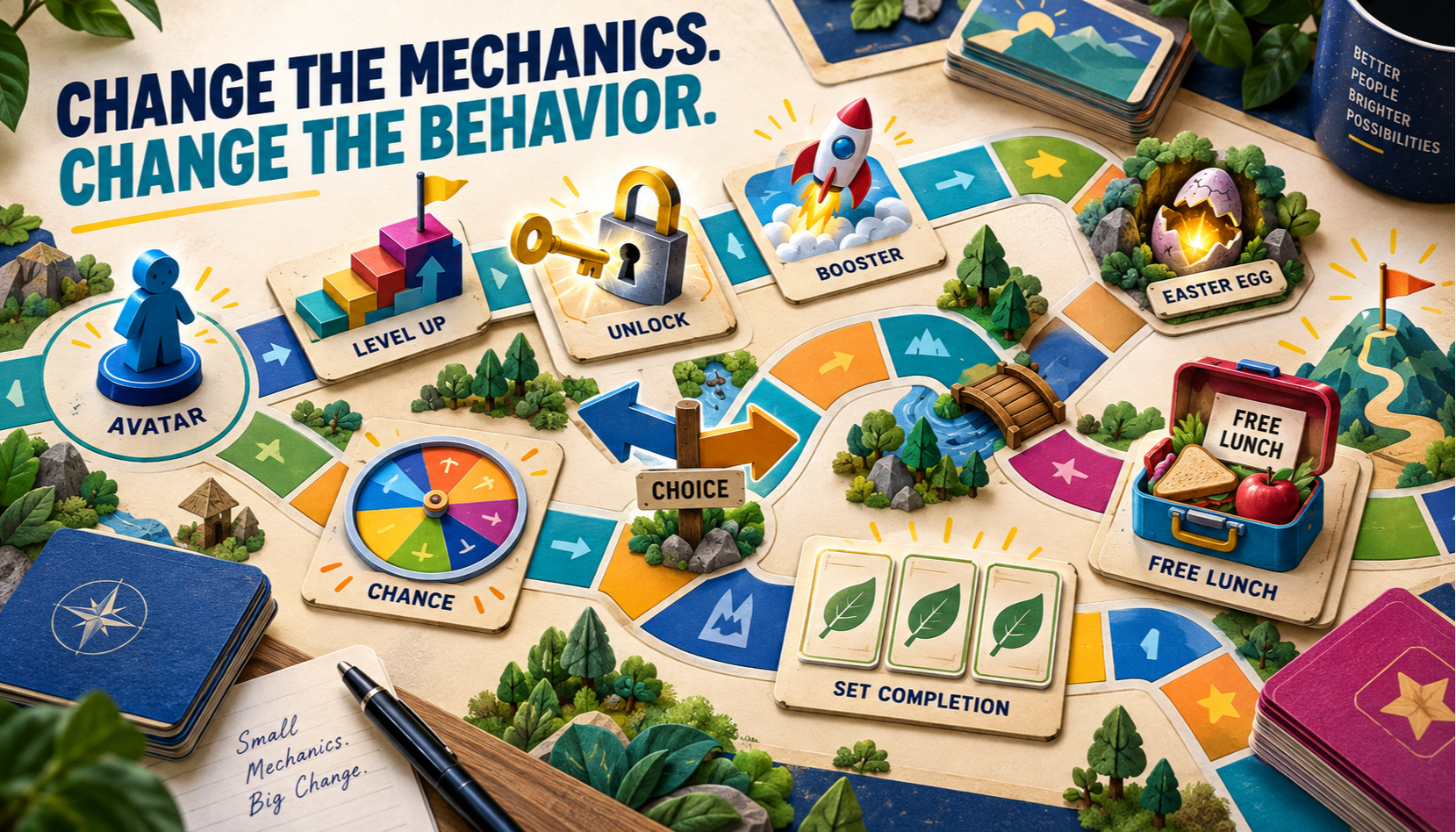
Change the Mechanics. Change the Behavior.
Sep 20, 2026Ask a room full of learning professionals what gamification means, and the answers usually come quickly: points, badges, and leaderboards.
I do not immediately tell them they are wrong because they are not. Those are game mechanics, and mechanics matter. They are not the entire design.
A mechanic tells the learner what they can do, what happens when they do it, and what they might try next. It creates action, response, and consequence. Without mechanics, even the most attractive learning experience can become little more than information waiting to be consumed.
The problem is not that learning professionals think gamification is about mechanics. The problem is that we have allowed the word mechanics to become shorthand for the same three ideas: points, badges, and leaderboards.
Game mechanics offer us so much more.
A learner can make a meaningful choice, accept a role, manage a limited resource, unlock information, discover a clue, negotiate with another player, test a strategy, experience a consequence, or try again after failure. Each mechanic changes what the learner is asked to do.
That matters because every learning experience already has mechanics, even when we do not call them that.
In a typical asynchronous course, the learner reads, watches, clicks Next, answers a few questions, and receives a completion mark. In a typical presentation, the learner listens, takes notes, and waits for the speaker to advance the slides. Those are mechanics. They tell the learner how to participate. They also tell the learner how little participation is required.
If the primary mechanics are watching, clicking, and recalling, we should not be surprised when learners remain passive. They are responding exactly as the experience was designed to have them respond. Gamification gives us the ability to change that design.
- Instead of asking a new manager to read five pages about giving feedback, we can place that manager inside a difficult conversation and require a choice. The choice produces a response from the employee, and that response creates the next decision.
- Instead of telling customer service employees how to handle an unreasonable customer, we can give them limited information, competing priorities, and several possible responses. They must decide what matters most and then experience the consequence of that decision.
- Instead of asking someone to memorize the steps in a safety process, we can challenge them to identify a risk, choose an action, and see what happens when an important step is missed.
The content may not have changed very much. The mechanics changed what the learner did with the content. That is the power of gamification.
It transforms information into action. It gives the learner something to decide, attempt, test, discover, or improve. It creates feedback while there is still time to adjust.
This is also why randomly adding game mechanics rarely produces the experience we hoped for. A leaderboard encourages competition and comparison. A countdown creates urgency. A limited resource forces prioritization. A role changes perspective. An unlock can create curiosity and progress.
None of those mechanics is automatically good or bad. Each one produces a different kind of pressure, choice, or response. The designer’s job is to understand what the mechanic encourages and decide whether that behavior supports the purpose of the learning.
If collaboration matters, do not choose mechanics that reward people for protecting information from one another. If thoughtful judgment matters, do not create so much time pressure that learners begin guessing. If confidence matters, do not design failure as humiliation.
The mechanic is never just decoration. It communicates what matters.
This is where intentional gamification becomes one of the most practical tools available to a learning designer. You do not need a custom gaming platform, an enormous budget, or advanced programming skills to begin. You need to know what you want the learner to do and which mechanics will make that action necessary.
A card can create a constraint. A timer can alter a decision. A role can reveal another point of view. A limited number of tokens can force a tradeoff. A branching scenario can make the learner live with the outcome of a choice.
Small changes in the mechanics can create substantial changes in the experience.
That does not mean every program needs boss battles, fantasy characters, competition, or an elaborate storyline. It means every program deserves a closer look at how learners are being asked to participate.
- Are they receiving information, or are they using it?
- Are they repeating the correct answer, or are they making a judgment?
- Are they being told what could happen, or are they experiencing the consequence?
- Are they completing the course, or are they practicing the behavior?
When we change the mechanics, we stop asking learners to prove that they were present. We begin asking them to show us what they can do. That is the shift.
Gamification is not simply a way to make learning more colorful or entertaining. It is a design process for creating action, feedback, progress, choice, and consequence. It gives us practical ways to move learners from knowing to doing.
Change the mechanics, and you change the experience. Change the experience, and you create the conditions for different behavior.
Learn How to Choose the Right Mechanics
Our next Level 1 Gamification Surveyor Certification will be held live online on September 29–30 from 10:00 a.m. to 2:00 p.m. Central each day.
You will learn Sententia’s research-based process for connecting learner motivation, learning objectives, desired behavior, and game mechanics. You will also use selected Quest Cards to clarify your design decisions before development begins.
This is not a course about adding points and badges to training. It is a hands-on certification that teaches you how to choose mechanics with purpose and use them to create learning experiences that ask people to think, decide, practice, and improve.
Participants can earn 6 ATD, SHRM, and HRCI recertification credits. Payment plans are available.
Don't miss a beat!
New moves, motivation, and classes delivered to your inbox.
We hate SPAM. We will never sell your information, for any reason.