
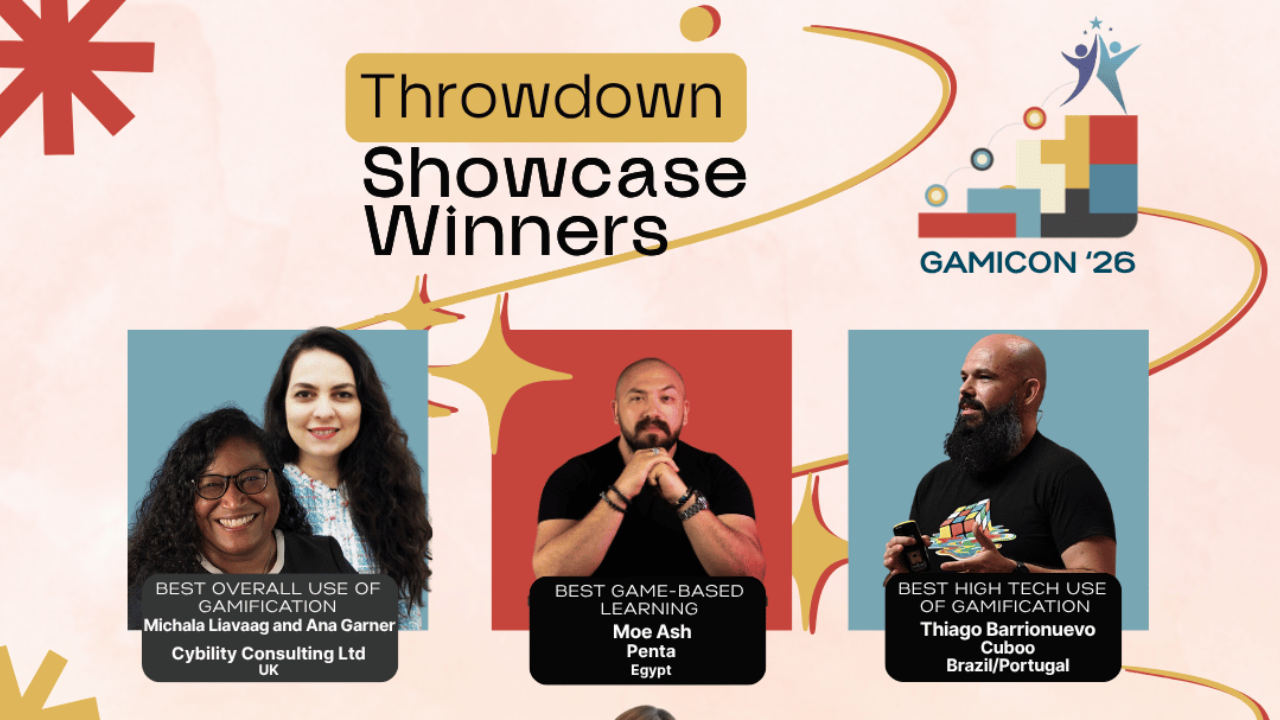
The Best Gamification and Game-Based Learning Projects of 2026
Apr 17, 2026This Is What “Not Average” Looks Like
There’s a moment in every GamiCon where ideas stop being theoretical and start becoming real. They are tested, played, challenged, and experienced in ways that go far beyond slides or discussion. That moment is the Throwdown Showcase, and it consistently delivers some of the most practical, thoughtful, and actionable work in the field.
This year’s finalists did not design for surface-level engagement. They designed for application, behavior change, and real-world performance. The projects pushed beyond “good ideas” and into experiences people can actually use. The winners reflect what happens when design is intentional and aligned to outcomes that matter.
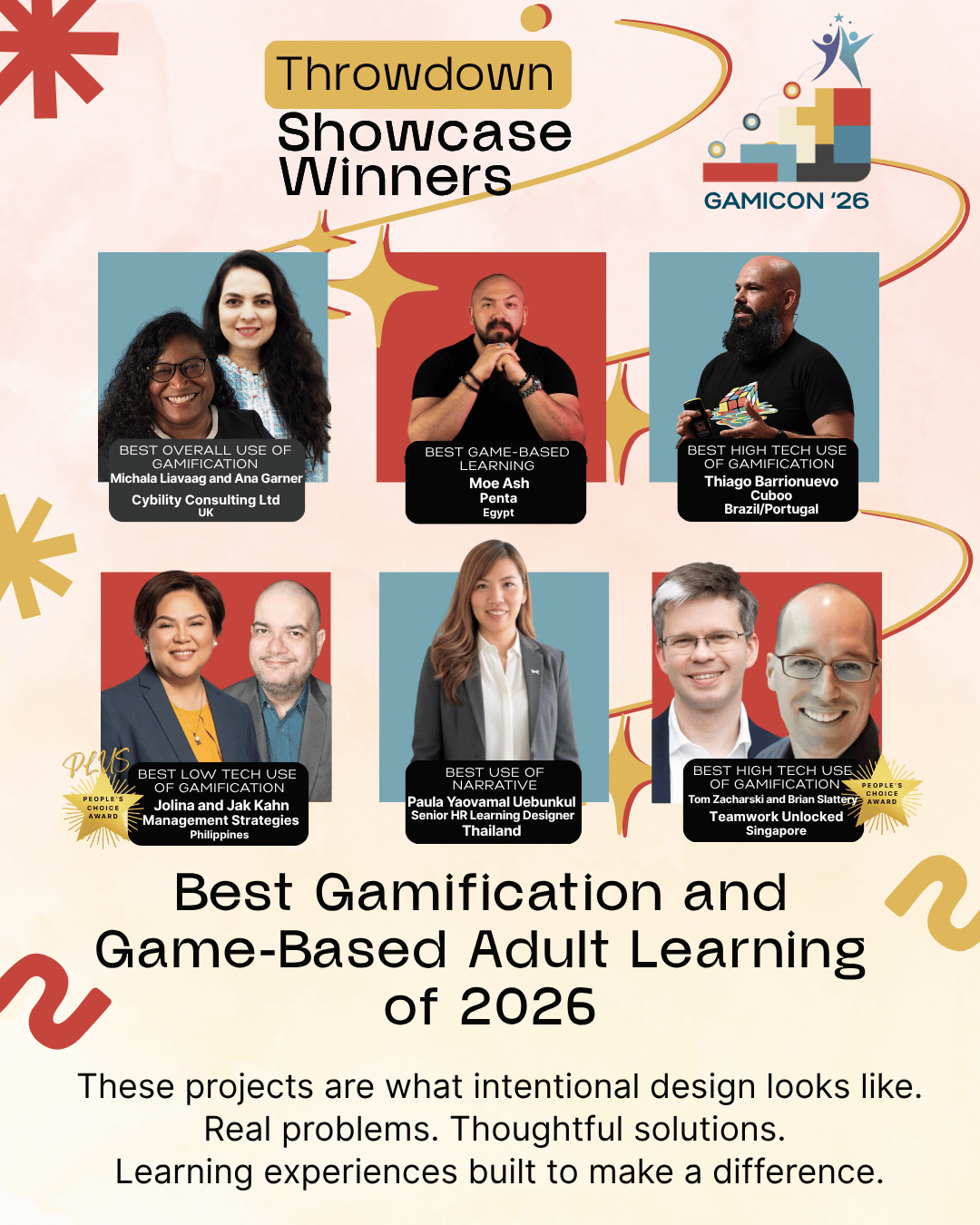
Best Overall Use of Gamification
Michala Liavaag & Dr. Ana Garner – Cyber Security Incident Response Team
This project stood out because it does exactly what gamification is meant to do. It connects directly to performance in a meaningful way. Designed around a high-stakes, real-world scenario, participants are not just learning about cybersecurity response. They are stepping into it, making decisions, collaborating under pressure, and seeing the consequences of their choices.
Everything in the experience is aligned. The roles, the structure, the decisions, and the feedback all support the objective. This is gamification done right, not layered on top as decoration, but built into the experience from the beginning.
Best Game-Based Learning
Moe Ash – PENTA
Moe Ash’s work stood out for bringing structure to the creative process of game design. The PENTA Deck is a design thinking framework that helps create serious learning games focused on measurable behavior change. It blends behavioral science, systems thinking, and game mechanics into a process that is both practical and repeatable.
What makes this powerful is its clarity. Designers move through a structured sequence that guides decisions around purpose, mechanics, and experience. The focus is always on impact. As Moe makes clear, it is about decisions first and measurable outcomes, not just activity. This is the kind of tool that strengthens the discipline of game-based learning.
Best High Tech
Thiago Barrinuevo – Survivors
Survivors demonstrates what happens when technology is used with purpose. This is not technology for the sake of engagement. It is technology used to create an immersive environment where decisions matter and consequences are experienced.
Participants are placed inside the experience and asked to think, respond, and adapt. The result is a deeper level of involvement and learning. Thiago’s work shows that when used well, high tech can enhance the experience by making it more immediate, more interactive, and more meaningful.
Best Use of Narrative
Paula Yavomal Uebunkul – AstroLead
Narrative is often discussed in learning design, but it is not always used effectively. AstroLead stands out because the story is not an add-on. It is central to the experience. The narrative provides context, direction, and meaning, guiding participants through decisions and keeping them engaged.
This is storytelling used with intention. It supports the learning rather than distracting from it. The result is an experience where participants are pulled forward by the story while still focused on the outcomes that matter. It is a strong example of narrative as a driver of learning, not just a layer.
Best Low Tech
Jak Kahn & Jolina Kahn – Monsters & Heroes
Monsters & Heroes is a powerful reminder that impactful learning does not require complex technology. This reflective card game creates space for honest conversation about behavior, particularly the responses that show up under stress.
The concept is simple and effective. We all have “Monsters,” the unproductive behaviors that surface under pressure, and “Heroes,” the strengths we can choose to lead with instead. The game helps participants recognize both and talk about them in a structured, meaningful way.
This is human-centered design at its best. It focuses on what people need to discuss and practice, rather than relying on flashy elements. The impact comes from the conversations it enables.
People’s Choice Awards
The People’s Choice Awards reflect what resonated most with participants in real time. These are the experiences that people connected with, remembered, and saw immediate value in.
Best Low Tech (People’s Choice)
Jak Kahn & Jolina Kahn – Monsters & Heroes
Best High Tech (People’s Choice)
Brian Slattery & Tom Zacharski – Submerged
These selections highlight the projects that participants could see themselves using and applying in their own work.
What This Year’s Winners Show Us
Looking across these projects, a clear pattern emerges. None of them rely on gimmicks or surface-level engagement. Instead, they are grounded in clarity of purpose, intentional design, and real-world application.
This reflects a broader shift in the field. We are moving away from “good enough” solutions and toward experiences that truly support how people think, decide, and act. The focus is no longer just on engagement, but on meaningful outcomes.
That is what the Throwdown is designed to showcase. And this year’s winners delivered on that promise.
If you want to experience these projects for yourself, the GamiCon48V recordings are available.
Use code PLAY50 for 50% off and step inside the experience.
Because this work is worth seeing.
Don't miss a beat!
New moves, motivation, and classes delivered to your inbox.
We hate SPAM. We will never sell your information, for any reason.